
Executive Summary
AI is accelerating the shift from a role-based labor market to a skills-based economy, creating a "skills mismatch economy" that redistributes economic value across the skills spectrum. Quantitative synthesis of over 150 million worker profiles and 100 million job postings reveals a profound disconnect between the "safe" generalist signals workers send and the specialized, execution-oriented capabilities employers reward [1][2].
Key Insights
1. Introduction & The Skills Mismatch Economy
The modern labor market is reorganizing at a pace that outstrips employers, workers, and educators' ability to adapt [7]. Traditional job titles, which once served as reliable proxies for professional capability, no longer accurately describe how work is actually performed [7]. Instead, we have entered a "skills mismatch economy," characterized by a profound disconnect between the signals workers send and the capabilities employers are willing to reward [7].
To bring empirical clarity to this transition, the Wharton AI & Analytics Initiative and Accenture developed the Wharton-Accenture Skills Index (WAsX) [1][8]. This recurring, empirical benchmark tracks more than 150 million unique U.S. profiles and 100 million job postings since 2022, mapping jobs at the task and skill level and linking them to economic value in an AI-enabled economy [1][2][9].
The core finding of the WAsX is a striking and persistent disconnect: workers overwhelmingly highlight broad, generalist traits (leadership, communication, teamwork, problem-solving) on their resumes and profiles [1][3]. These signals feel safe and familiar, but they appear so frequently that they offer zero differentiation [1][3]. In contrast, employers face deep and consistent deficits in specialized, execution-oriented skills (technical depth, scientific fluency, digital and analytical precision, operational expertise) that determine whether work moves from concept to completion [1][3].
2. The Economics of Skills & Role-Specific Pricing
A critical contribution of the WAsX is the revelation that skill value is role-specific, not universal [2][4]. A capability that boosts pay in one industry or role can actually lower compensation in another [2][4]. This challenges the long-standing assumption that some skills are always "high value," proving instead that value is governed by the micro-economy of each specific role [2][4].
For example, the index found that signaling "strategic analysis" skills is correlated with an $8,000 salary increase for sales representatives, but a $10,000 salary decrease for technical validation leads [2][4]. In highly technical engineering and scientific roles, domain depth is more economically valued than general strategic capability, which employers may perceive as a distraction from core execution or associate with lower-value administrative responsibilities [10].
Life Sciences Case Study: Role-Level Skill Economics
The Life Sciences sector offers a vivid example of these dynamics in practice [10]. While professionals in this sector overwhelmingly emphasize broad traits like communication and high-level leadership, employers face severe shortages in specialized capabilities like scientific methods, lab techniques, analytical chemistry, and environmental management [10].
Table 1: Life Sciences Case Study: Role-Level Skill Economics
| Role | Salary-Increasing Skills (Wage Premium) | Salary-Decreasing Skills (Wage Discount) |
|---|---|---|
| Validation Lead (Technical Execution Role) |
• Catalytic reactor techniques • Liposome technologies • Enterprise coaching |
• Strategic analysis • Regulatory or healthcare management • Broader market-facing skills |
| Hospital Specialty Sales Rep (Commercial Execution Role) |
• Crisis management • Specification management • Concurrent engineering understanding • Pharmacokinetics knowledge |
• Strategic analysis • Digital payment solutions • Billing support • Routine productivity tools |
Source: Wharton-Accenture Skills Index (WAsX) Case Study on Life Sciences Roles [10].
3. AI's Talent Reset & McKinsey's Skill Partnerships
Artificial intelligence is acting as a massive catalyst for this shift, redistributing economic value across the skills spectrum [2][1][11]. Rather than simply automating work away, AI is reweighting the talent landscape [2][10]. Demand is falling sharply for routine content creation and structured, repeatable cognitive work, such as basic writing, routine analysis, and segments of software development [2][10].
Conversely, the market is placing a massive premium on capabilities that sit beyond AI's immediate reach and are grounded in expert judgment, contextual understanding, and hands-on execution [10]. This is heavily supported by McKinsey's 2025 research, "Agents, robots, and us: Skill partnerships in the age of AI," which projects that AI-powered automation could generate $2.9 trillion to $9.0 trillion of economic value in the United States by 2030 [12][13].
McKinsey's research highlights that demand for "AI fluency"—the ability to use and manage AI tools—has jumped nearly sevenfold (7x) in the two years through mid-2025, becoming a job requirement in occupations employing about seven million workers [12][5]. Meanwhile, job listings are declining for skills that machines already perform well, such as routine writing, basic research, and simple mathematics [12][5].
Figure 1: AI Fluency Demand Growth vs. Routine Skills Decline (Indexed, 2023-2025)
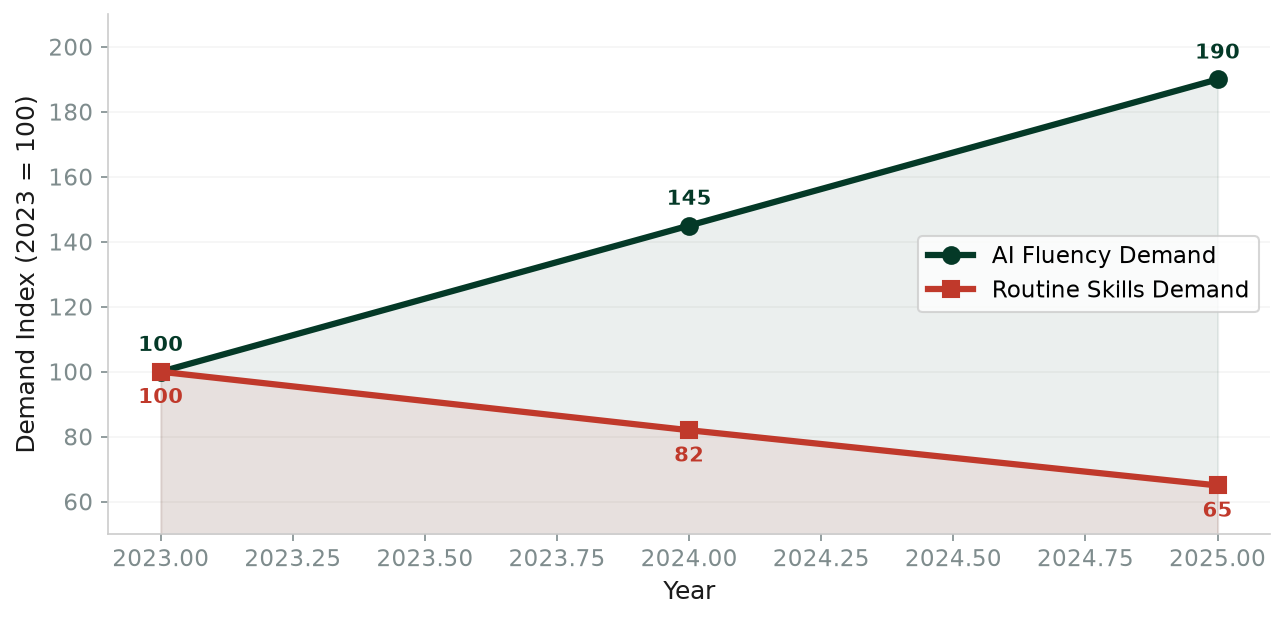
Source: McKinsey Global Institute, Agents, robots, and us: Skill partnerships in the age of AI [12].
The Perception Gap: C-Suite vs. Employee Reality
McKinsey's 2025 survey also reveals a significant disconnect between business leaders and employees regarding the depth of AI integration [14]. While nearly all employees (94%) and C-suite leaders (99%) report familiarity with Gen AI, leaders severely underestimate how extensively their employees use these tools [14]. C-suite leaders estimate that only 4% of employees use Gen AI for at least 30% of their daily work, when in fact the actual self-reported figure is 12% (three times greater) [14].
4. Brookings' Adaptive Capacity & Pew's Perception Gap
The structural transition to an AI-enabled skills economy is not without friction. Brookings Institution's 2026 research highlights the uneven distribution of AI exposure and adaptive capacity across the U.S. workforce [6]. Of the 37.1 million U.S. workers in the top quartile of occupational AI exposure, 26.5 million possess high adaptive capacity, positioning them well for job transitions [6].
However, Brookings identifies a highly vulnerable segment of 6.1 million workers who face both high AI exposure and low adaptive capacity [6]. These workers are heavily concentrated in clerical and administrative roles, and 86% are women, creating a significant gender-equity challenge in the transition [6].
This transition friction is further compounded by a profound perception gap documented by the Pew Research Center (2025) [15][16]. Pew's survey reveals that workers do not recognize the shifting economic value of skills. Only 35% of employed adults believe AI skills are extremely or very important for success today, whereas over 70% of workers continue to rate interpersonal skills, written/spoken communication, and critical thinking as the most critical capabilities [15][16]. This misalignment explains why workers continue to over-signal generalist traits on resumes, unaware that the market is actively discounting them in favor of specialized technical depth [1][2][3].
Figure 2: Worker Skill Importance Perception vs. Market Demand (Pew 2025)
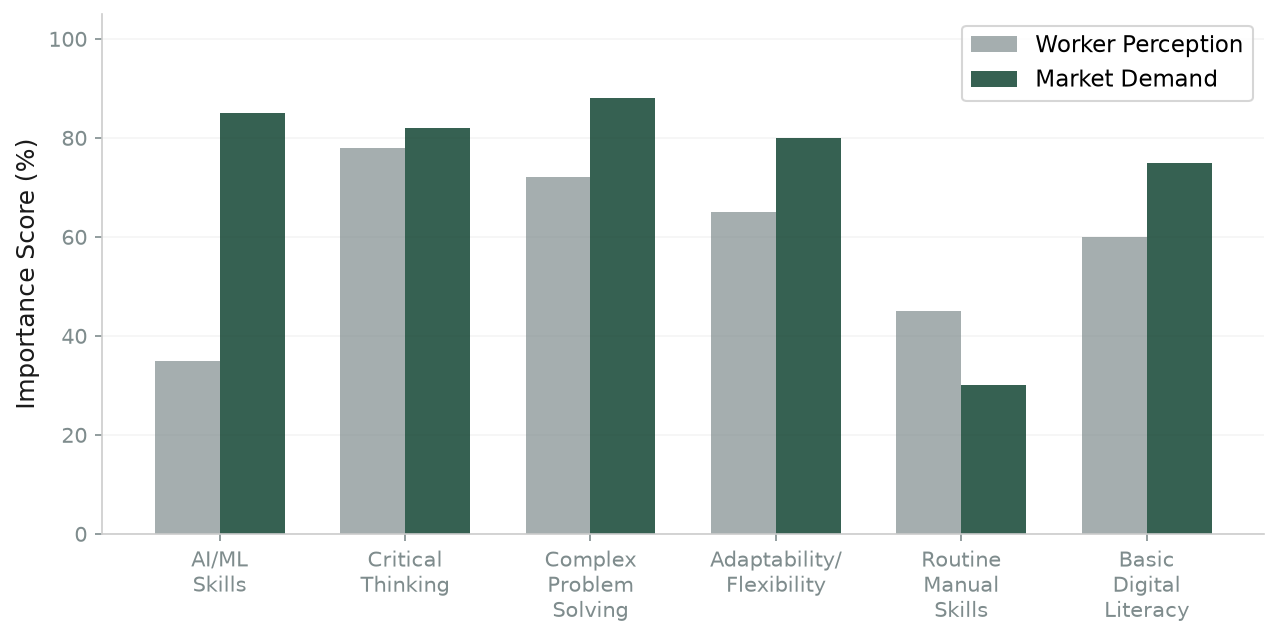
Source: Pew Research Center, Which workers use AI in their jobs [15].
5. Cross-Study Synthesis & Comparative Analysis
Consolidating these four major studies reveals a highly consistent narrative: the labor market is undergoing a structural shift from roles to skills, accelerated by AI, where the primary bottleneck is a massive mismatch between worker signaling and employer demand.
Table 2: Cross-Study Synthesis & Comparative Analysis
| Study / Source | Core Focus & Dataset | Key Findings & Metrics | Strategic Implication |
|---|---|---|---|
| Wharton-Accenture Skills Index (WAsX) (Jan 2026) [1] |
150M+ profiles, 100M+ job postings [1][2] | "Skills Mismatch Economy." Generalist skills in surplus; specialized execution in deficit [1][3]. Skill value is role-specific (e.g., strategic analysis: +$8k in sales, -$10k in validation) [2][4]. | Deconstruct roles into tasks; align compensation with role-level skill economics [9][1]. |
| McKinsey & Company (Nov 2025) [12] |
Global employer/employee surveys [17] | AI fluency demand grew 7x in 2 years (7M workers affected) [12][5]. Gen AI usage is 3x higher than C-suite estimates (12% vs. 4% of employees using AI for 30%+ of work) [14]. | Build "skill partnerships" between humans, agents, and robots; invest in AI capability building [12][17]. |
| Brookings Institution (Jan-Apr 2026) [18][6] |
U.S. workforce demographic analysis [6] | 37.1M workers highly exposed to AI [6]. 6.1M workers face high exposure and low adaptive capacity (86% women, clerical roles) [6]. 11M STARs in highly exposed Gateway roles [19]. | Target transition support and short-term training pathways for vulnerable populations (STARs) [18][19]. |
| Pew Research Center (Feb 2025) [15] |
U.S. worker sentiment surveys [20] | 52% of workers worried about AI's impact [20]. Only 35% value AI skills, while 70%+ value generalist communication/interpersonal skills [15][16]. | Address the worker perception gap; rebalance training toward economically scarce, AI-integrated skills [15][16]. |
Source: SkyWise Private Equity Analysis of Wharton-Accenture [1], McKinsey [12], Brookings [18], and Pew Research [15].
6. Risk Assessment & Portfolio Implications
For Private Equity and Asset Management, the transition to a skills-based economy introduces significant operational and valuation risks across portfolio companies. We categorize these risks into four primary vectors:
Table 3: Risk Assessment & Portfolio Implications
| Risk Category | Severity | Impact Vector | Mitigation Strategy |
|---|---|---|---|
| Transition Friction Risk | High | Slower time-to-hire, operational bottlenecks, and lost productivity due to acute shortages in specialized execution skills [1][10]. | Implement WAsX-style skill diagnostics at the portfolio level to target reskilling investments precisely [21][1]. |
| Compensation Misalignment Risk | Moderate | Overpaying for abundant generalist traits while under-compensating and losing scarce, high-value technical talent [21][1]. | Deconstruct job descriptions and align compensation structures with role-level skill economics [21][1]. |
| Gender & Equity Risk | High | Disproportionate displacement of female workers in clerical/administrative roles (86% of the 6.1M vulnerable workers) [6]. | Establish targeted upskilling and transition pathways for administrative staff into AI-augmented roles [18][19]. |
| Perception & Adoption Risk | Moderate | Underestimating employee AI usage (C-suite 3x gap) leading to shadow AI adoption, security risks, and uncaptured productivity gains [14]. | Formalize AI fluency training and establish clear guidelines for human-agent-robot collaboration [12][17]. |
Source: SkyWise Private Equity Analysis of Wharton-Accenture [1], McKinsey [12], Brookings [18], and Pew Research [15].
7. Conclusion & Strategic Recommendations
The synthesis of WAsX, McKinsey, Brookings, and Pew research demonstrates that skills are the new currency of the labor market [8][1]. To maximize portfolio value and operational efficiency in an AI-first economy, SkyWise Private Equity recommends that portfolio company executives immediately transition from a job architecture to a skill architecture [1].
Actionable Playbook for Portfolio Companies:
- Diagnose Skill Surpluses and Deficits: Stop hiring based on generic job titles. Use empirical skill mapping to identify where teams are saturated with generalist traits and where they lack specialized, execution-oriented capabilities [21][1].
- Redesign Roles Around Human-AI Collaboration: Break roles down into their underlying tasks. Allocate routine cognitive tasks (writing, basic analysis) to AI agents, and redesign human roles around expert judgment, compliance, and domain-specific execution [21][1][9].
- Align Compensation with Skill Economics: Stop paying wage premiums for abundant generalist skills. Align compensation with role-level skill economics, rewarding the scarce, high-value capabilities that directly drive performance [21][1].
- Rebuild Job Descriptions Around Specific Skill Profiles: Replace broad, non-specific requirements with precise capability expectations (e.g., naming specific tools, techniques, and applied experiences) to improve hiring speed and match quality [21][1].
Sources & References
- Wharton AI & Analytics Initiative & Accenture (January 2026). The Skills Mismatch Economy: Insights from the Wharton-Accenture Skills Index (WAsX). Knowledge at Wharton. Available at: https://knowledge.wharton.upenn.edu/special-report/2025-wharton-accenture-skills-gap-index/
- AllWork.Space (January 2026). Do Your Job Title And Resume Suddenly Feel Meaningless? Welcome To The Skills Mismatch Economy. Available at: https://allwork.space/2026/01/do-your-job-title-and-resume-suddenly-feel-meaningless-welcome-to-the-skills-mismatch-economy/
- Inkl (January 2026). Welcome to the 'skills mismatch economy': The shift from roles to skills. Available at: https://www.inkl.com/news/welcome-to-the-skills-mismatch-economy-the-shift-from-roles-to-skills-is-making-your-resume-and-your-job-title-worthless
- AllWork.Space (January 2026). Do Your Job Title And Resume Suddenly Feel Meaningless? Welcome To The Skills Mismatch Economy. Available at: https://allwork.space/2026/01/do-your-job-title-and-resume-suddenly-feel-meaningless-welcome-to-the-skills-mismatch-economy/
- Radensa Newsletter (December 2025). Agents, robots, and us: Skill partnerships in the age of AI. Available at: https://newsletter.radensa.ru/wp-content/uploads/2025/12/McKinsey_Agents-Robots-Us_2025-60-pgs.pdf
- Brookings Institution (January 2026). Measuring US workers' capacity to adapt to AI-driven job displacement. Available at: https://www.brookings.edu/articles/measuring-us-workers-capacity-to-adapt-to-ai-driven-job-displacement/
- Fortune (January 2026). Welcome to the 'skills mismatch economy': The shift from roles to skills. Available at: https://fortune.com/2026/01/22/skills-mismatch-economy-wharton-accenture-eric-bradlow-interview-will-ai-replace-jobs/
- Wharton Magazine (Spring/Summer 2026). AI's Talent Reset. Available at: https://magazine.wharton.upenn.edu/issues/spring-summer-2026/ai-talent-reset/
- Accenture (June 2026). The Age of Co-intelligence. Available at: https://www.accenture.com/us-en/insights/strategy/age-of-co-intelligence
- Wharton-Accenture Skills Index (WAsX) Case Study on Life Sciences Roles (January 2026). Available at: https://knowledge.wharton.upenn.edu/wp-content/uploads/2026/01/2026-Wharton-Accenture-Report-FNL.pdf
- Accenture (June 2026). The Age of Co-intelligence. Available at: https://www.accenture.com/us-en/insights/strategy/age-of-co-intelligence
- McKinsey Global Institute (November 2025). Agents, robots, and us: Skill partnerships in the age of AI. Available at: https://www.mckinsey.com/mgi/our-research/agents-robots-and-us-skill-partnerships-in-the-age-of-ai
- McKinsey Global Institute (November 2025). Agents, robots, and us: Skill partnerships in the age of AI. Available at: https://www.mckinsey.com/mgi/our-research/agents-robots-and-us-skill-partnerships-in-the-age-of-ai
- McKinsey Digital (January 2025). Superagency in the workplace: Empowering people to unlock AI's full potential at work. Available at: https://www.mckinsey.com/capabilities/mckinsey-digital/our-insights/superagency-in-the-workplace-empowering-people-to-unlock-ais-full-potential-at-work
- Pew Research Center (February 2025). Which workers use AI in their jobs. Available at: https://www.pewresearch.org/social-trends/2025/02/25/workers-exposure-to-ai/
- Pew Research Center (February 2025). Which workers use AI in their jobs. Available at: https://www.pewresearch.org/social-trends/2025/02/25/workers-exposure-to-ai/
- McKinsey & Company (April 2026). Closing Europe's workforce skills gap: Strategies for growth. Available at: https://www.mckinsey.com.br/capabilities/people-and-organizational-performance/our-insights/how-european-organizations-can-treat-skills-as-a-strategic-priority
- Brookings Institution (April 2026). How AI may reshape career pathways to better jobs. Available at: https://www.brookings.edu/articles/how-ai-may-reshape-career-pathways-to-better-jobs/
- Brookings Institution (April 2026). How AI may reshape career pathways to better jobs. Available at: https://www.brookings.edu/articles/how-ai-may-reshape-career-pathways-to-better-jobs/
- Pew Research Center (February 2025). U.S. Workers Are More Worried Than Hopeful About Future AI Use in the Workplace. Available at: https://www.pewresearch.org/wp-content/uploads/sites/20/2025/02/ST_2025.2.25_AI-Workers_REPORT.pdf
- Knowledge at Wharton (January 2026). Special Report: The AI Skills Gap. Available at: https://knowledge.wharton.upenn.edu/special-report/2025-wharton-accenture-skills-gap-index/
Important Disclosures & Disclaimers
This research memorandum is provided for informational purposes only and does not constitute investment advice, an offer to sell, or a solicitation to buy any securities. The analysis and recommendations herein are based on publicly available information, proprietary AI models, and machine learning algorithms that incorporate historical data and forward-looking projections.
Past performance is not indicative of future results. All investments involve risk, including possible loss of principal. SkyWise Private Equity and its affiliates may hold positions in the securities or portfolio companies discussed in this report.
Frequently Asked Questions
What is the skills mismatch economy?
The skills mismatch economy describes a labor market where the skills workers possess do not align with the skills employers need, increasingly driven by AI adoption. This mismatch creates structural unemployment, wage polarization, and requires significant workforce retraining investment.
How is AI reorganizing the labor market?
AI is reorganizing the labor market by automating routine tasks, creating demand for new technical and cognitive skills, shifting job requirements across industries, and widening the gap between high-skill and low-skill workers. This transformation requires proactive workforce development strategies.
What does the Wharton-Accenture Skills Index (WAsX) reveal?
The Wharton-Accenture Skills Index (WAsX) measures the evolving demand for skills in the AI era, revealing significant gaps between current workforce capabilities and future requirements. Combined with McKinsey, Brookings, and Pew Research data, it shows a systemic skills mismatch requiring coordinated response from educators, employers, and policymakers.
Published Jun 1, 2026 and not updated since. Personal views, not investment advice. See Disclosures.