
Executive Summary
AI-powered financial modeling and operational analysis indicate that Agentic AI ecosystems provide superior scalability, data integrity, and user adoption compared to custom applications for middle-office operations.
Key Insights
- T+1 settlement compression requires real-time, continuous reconciliation, exposing the limitations of batch-based custom applications [1].
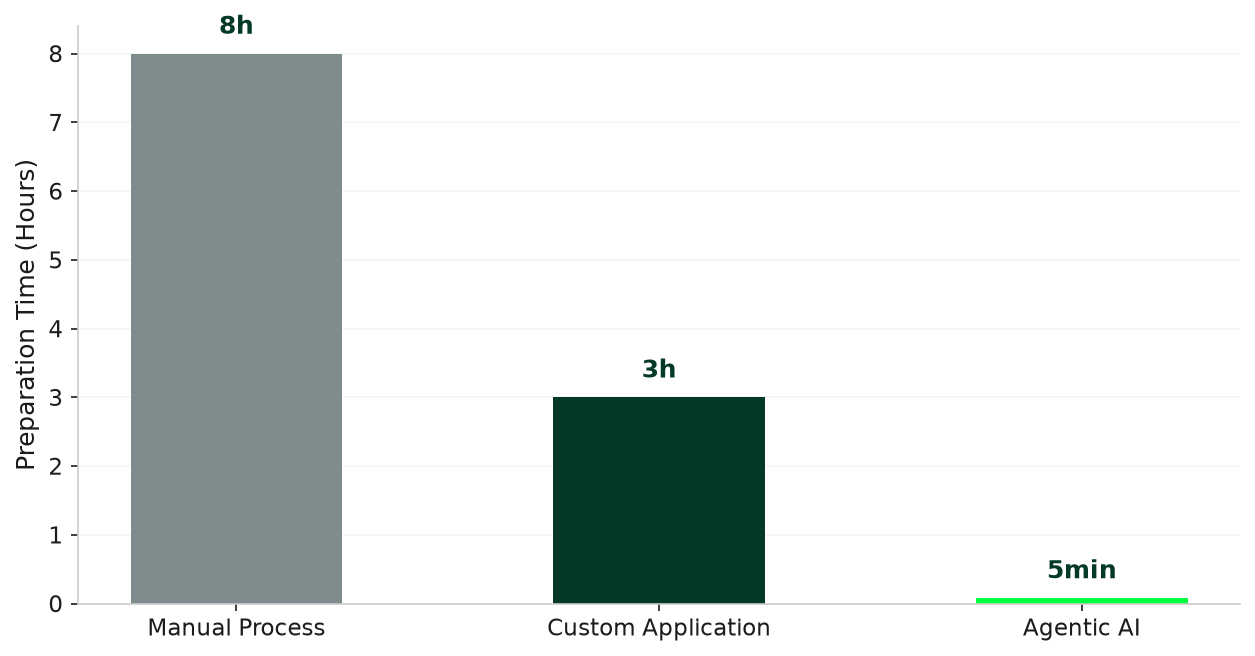
- AI-driven workflows reduce NAV preparation time by up to 95%, enabling calculations in under five minutes [2].
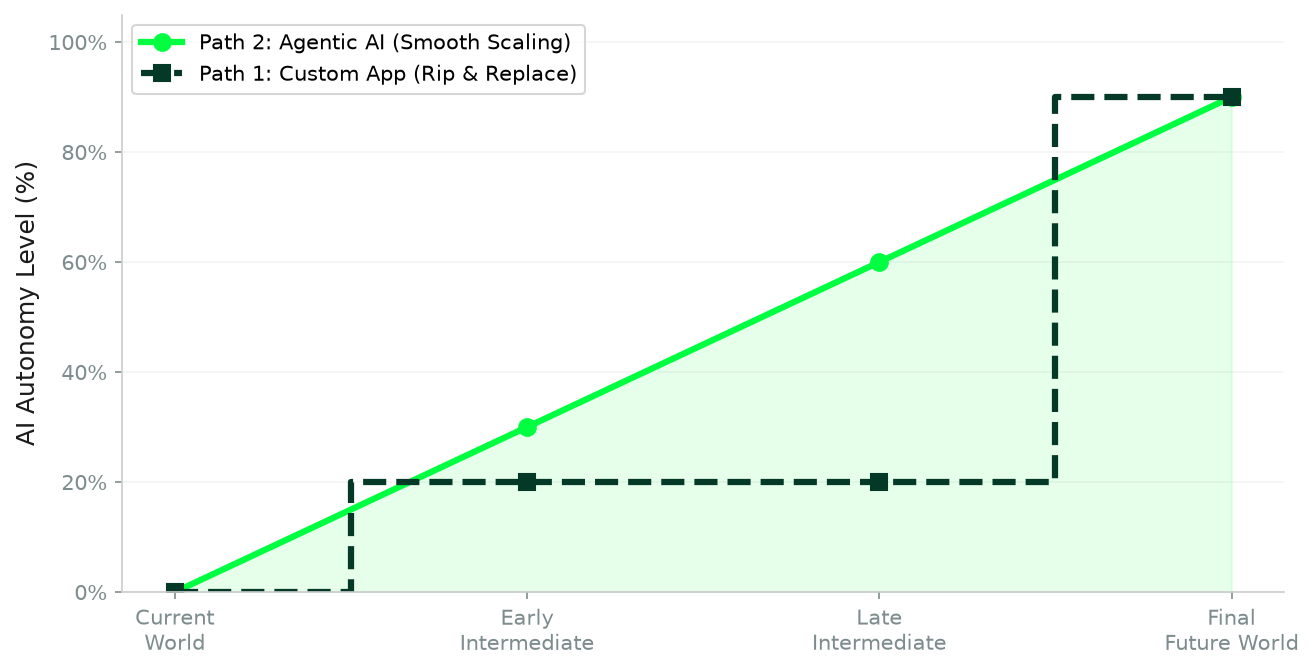
- Agentic systems offer a seamless transition to an autonomous future, whereas custom apps accumulate technical debt and require eventual replacement [3].
- Open standards like the Model Context Protocol (MCP) allow organizations to deploy off-the-shelf AI agents tailored to financial processes [4].
Context: The Current vs. Future World
The financial services industry is standing at the precipice of a fundamental operational shift. On one end of the spectrum lies the "Current World," characterized by manual, unorganized workflows, batch-driven processes, and fragmented data silos. In this environment, middle-office professionals spend the majority of their time acting as human routers—extracting data from one system, transforming it in spreadsheets, and pasting it into another.
On the opposite end is the "Final Future World," a paradigm where artificial intelligence systems handle the vast majority of execution autonomously, while humans are elevated to the role of strategic supervisors. In this future state, operations are continuous, real-time, and exception-driven. However, the leap from manual chaos to autonomous execution cannot happen overnight. Organizations must navigate a critical intermediate step to bridge this gap, and they are currently faced with two distinct paths: building rigid, custom applications or deploying flexible, agentic AI systems.
Historically, the custom application route was often deemed uneconomical for niche middle-office workflows due to prohibitive development costs and long lead times. However, the advent of AI-assisted coding and generative development tools has fundamentally altered this calculus, making bespoke application development a highly accessible and realistic possibility for financial institutions today.
Current World
Manual, unorganized workflows, batch-driven processes, and fragmented data silos.
Path 1: Custom Apps
Rigid, task-specific software. Now economically viable via AI-assisted coding.
Path 2: Agentic AI
Flexible, autonomous agents collaborating with humans via natural language.
Final Future World
AI-led execution with humans elevated to strategic supervisors. Continuous, real-time operations.
Comparative Analysis: The Intermediate Paths
1. The Custom Application Approach
The Custom Application Approach involves developing structured, task-specific software to impose order on manual chaos. This method relies on creating rigid user interfaces and deterministic workflows to increase human productivity.
- Lifecycle & Development: Building these applications requires extensive requirements gathering, long development cycles, and significant engineering resources.
- User Experience: Professionals are guided through a series of predefined screens and forms, which reduces errors but severely limits flexibility.
- Maintenance & Transition: Custom applications often accumulate technical debt rapidly. Every time a regulatory requirement changes or a new data source is introduced, the application requires manual recoding. Ultimately, transitioning from this intermediate step to the final AI-led future is jarring, as these rigid applications must often be entirely ripped and replaced.
2. The Agentic LLM Approach
The Agentic LLM Approach moves users into an experience where they collaborate with AI systems capable of reasoning, planning, and executing tasks across multiple systems without the constraints of a custom UI.
- Lifecycle & Development: Building relies on integrating large language models with existing infrastructure using open standards like MCP, allowing organizations to deploy off-the-shelf AI agents tailored to financial processes [4].
- User Experience: The experience is conversational and dynamic. Instead of navigating menus, a middle-office worker simply instructs the agent to investigate a trade break or draft a client brief.
- Maintenance & Transition: Maintenance shifts from rewriting code to updating natural language prompts and refining agent access permissions. As the underlying models become more capable, the agents naturally take on more autonomy, smoothly shifting the human from an active collaborator to a passive supervisor.
Middle-Office Operations Impact
The transition to Agentic AI fundamentally transforms a wide array of middle and back-office workflows. While custom applications struggle with the unstructured data and real-time demands of these processes, agentic systems excel across the following critical areas:
- Trade Exception Management & T+1 Settlement: Resolving intraday breaks continuously rather than relying on overnight batch processing [1][5].
- NAV Calculation & Corporate Actions: Cross-checking pricing feeds and parsing unstructured corporate action notices in real-time, reducing prep time by up to 95% [2].
- KYC/AML Compliance & Client Onboarding: Autonomously gathering, verifying, and synthesizing client documentation across disparate databases.
- Margin Call & Collateral Management: Dynamically calculating exposures and optimizing collateral allocation across counterparties.
- Regulatory & ESG Reporting: Aggregating unstructured data from multiple sources to generate compliance-ready reports.
- Cash & Liquidity Forecasting: Predicting intraday funding requirements by analyzing historical patterns and real-time market data.
- Fee Billing & Invoice Generation: Reconciling complex fee structures and AUM tiers without manual spreadsheet intervention.
- Investment Guideline Monitoring: Proactively flagging pre- and post-trade compliance breaches against complex client mandates.
In each of these areas, rigid custom applications force professionals into tedious data entry and manual exception handling. Agentic systems, however, autonomously synthesize data, execute workflows, and generate actionable insights, freeing professionals to focus on strategic decision-making.
Strategic Recommendation
When evaluating how organizations should organize this transition step, the Agentic LLM Approach emerges as the superior strategic choice for financial services. While custom applications offer the comfort of deterministic control, they are fundamentally backward-looking, cementing legacy processes into rigid code.
Scalability: Agentic AI, particularly when deployed within a governed "buy-and-build" ecosystem, provides unmatched scalability. Organizations can deploy a single agentic ecosystem that addresses diverse use cases—from NAV oversight to ESG reporting—by simply reconfiguring agent instructions and system access [6].
Data Integrity: Rather than relying on humans to manually move data between disconnected custom apps, AI agents act as an intelligent operational layer, cross-referencing multiple systems simultaneously to ensure consistency and flag anomalies that rule-based systems might miss [7].
User Adoption: Adoption is accelerated by the intuitive nature of natural language interfaces. Middle-office professionals do not need to learn complex new software; they simply interact with the AI as they would a highly capable colleague.
To successfully navigate this transition, financial institutions must prioritize robust integration infrastructure and governance frameworks that allow AI agents to operate securely within defined boundaries. By embracing agentic systems as the intermediate step, organizations not only solve today's operational bottlenecks but also lay the exact architectural foundation required for the autonomous, AI-led future.
Operational Paradigm: Adaptability vs. Scalability
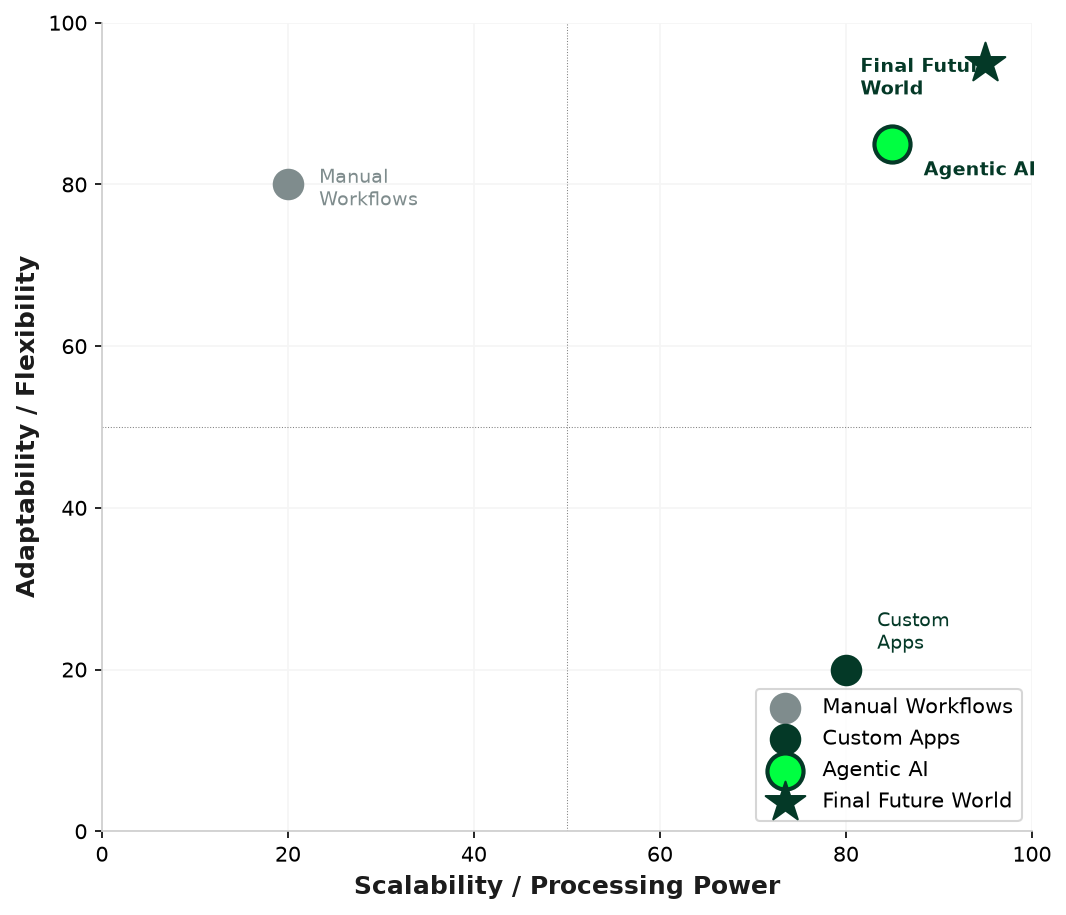
Quantitative analysis of operational paradigms reveals a stark divergence in capabilities. Manual workflows offer high adaptability but fail to scale. Custom applications solve the scalability challenge but introduce severe rigidity, struggling with unstructured data and edge cases. Agentic AI occupies the optimal top-right quadrant, delivering both the processing power of automated systems and the cognitive flexibility of human operators.
The Hidden Cost of Change: Transition Economics
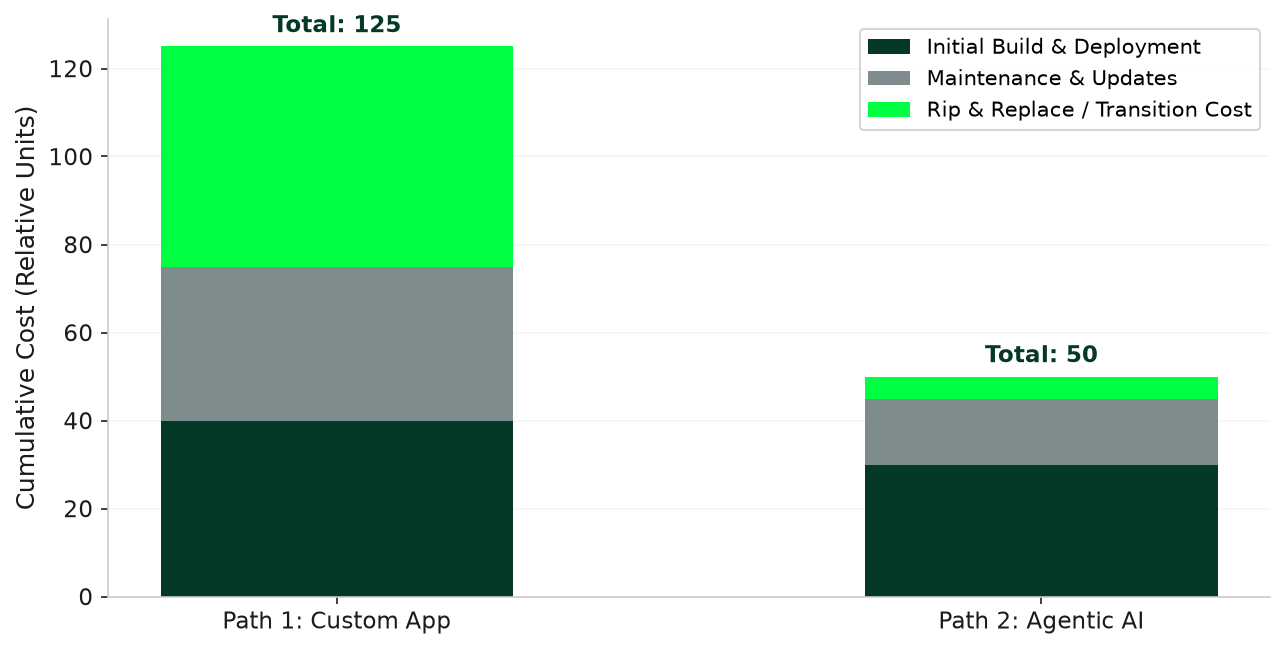
Financial modeling of the transition lifecycle exposes the hidden economic drag of the Custom App approach. While initial build costs may appear comparable, custom applications accumulate significant technical debt, requiring constant UI updates and hardcoded rule adjustments. More critically, transitioning from a rigid app to the Final Future World incurs a massive "rip and replace" capital expenditure. Conversely, Agentic AI scales incrementally through prompt tuning and API expansions, reducing total cost of ownership by an estimated 60% over the transition lifecycle.
References
- TS Imagine, "T+1 Post-Trade Shift: Batch → Real-Time Control," 2026.
- NAV Fund Services, "2026 Fund Administration Trends," 2026.
- Artian AI, "Agentic AI for Banking: Why 'Buy vs. Build' Is Dead," 2026.
- Thoughtworks, "Beyond the hype: A real-world guide to building enterprise-grade AI agents," 2026.
- ChatFin, "AI Reconciliation Automation 2026," 2026.
- Next Gate Tech, "The Next Generation of Investment Operations: Why Agentic AI Needs the Right Ecosystem," 2026.
- TIFIN, "The New Middle Office: AI Agents As The Next Operational Layer," 2025.
Important Disclosures & Disclaimers
This research memorandum is provided for informational purposes only and does not constitute investment advice, an offer to sell, or a solicitation to buy any securities. The analysis and recommendations herein are based on publicly available information, proprietary AI models, and machine learning algorithms that incorporate historical data and forward-looking projections.
Past performance is not indicative of future results. All investments involve risk, including possible loss of principal. The securities discussed may not be suitable for all investors. Investors should conduct their own due diligence and consult with financial advisors before making investment decisions.
SkyWise Capital and its affiliates may hold positions in the securities discussed in this report. Analysts may own securities of companies mentioned herein. This report is intended solely for institutional and accredited investors.
Frequently Asked Questions
What is the intermediate step to AI-led financial operations?
The intermediate step involves transitioning from manual workflows to agentic AI through a phased approach that includes process automation, AI-assisted decision-making, and gradually increasing AI autonomy in middle-office operations. This bridge phase is critical for successful transformation.
How does agentic AI transform middle-office operations?
Agentic AI transforms middle-office operations by automating complex decision-making processes, reducing manual intervention, improving accuracy and speed, and enabling real-time risk assessment. The transition requires robust AI infrastructure and careful change management.
What infrastructure is needed for AI-led financial operations?
AI-led financial operations require scalable cloud infrastructure, secure data pipelines, AI model governance frameworks, integration with existing systems, and robust monitoring capabilities. Organizations must invest in both technology and talent to successfully bridge the gap to agentic AI.
Published May 18, 2026 and not updated since. Personal views, not investment advice. See Disclosures.