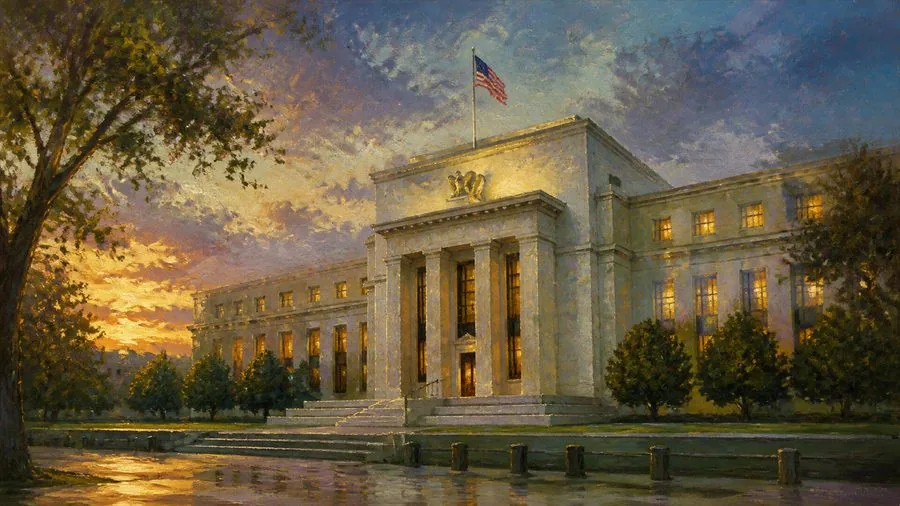
If you had to pick a single word to describe the Federal Reserve's 2026, it would be inflection. Chair Jerome Powell's term expires on May 15, 2026, and the convergence of a leadership transition, sticky inflation, and an administration that has made no secret of its desire to influence monetary policy has created the most consequential test of central bank independence since the Volcker era. The decisions made over the next twelve months won't just move rates—they'll shape the credibility of the institution that anchors the world's reserve currency for a generation.
The Central Thesis
Here's the bottom line: the Fed faces its most significant test of independence in decades. Our analysis points to a 65% probability of gradual policy normalization, with the federal funds rate drifting down to a 3.0–3.25% range—contingent on the new chair maintaining operational autonomy. The alternative scenarios, while less likely, carry far higher stakes.
The backdrop is a classic dual-mandate tension. The base case projects 2.0–2.5% GDP growth, 3.7–4.2% unemployment, and 2.2–2.8% core PCE inflation. A cooling labor market is pulling the Fed toward easing; sticky inflation is pulling it toward patience. That tension is precisely what makes the independence question so urgent—if politics tilts the scale, the costs compound.
Former Chairs Raise the Alarm
In an unprecedented joint op-ed in The New York Times in July 2025, former Fed Chairs Ben Bernanke and Janet Yellen issued their most forceful public defense of institutional autonomy in decades. Their argument was elegant in its simplicity: independence doesn't mean a lack of democratic accountability. Congress sets the goals—maximum employment and stable prices—and the Fed reports on its progress. Independence simply means policymakers can use fact-based analysis and professional judgment to reach those goals, free from the short-term political incentives of elected officials.
They made three points worth remembering. First, independence is a feature of democratic governance, not a bug. Second, countries with independent central banks achieve lower and more stable inflation with no sacrifice in long-term employment. Third—and most critically for markets—credibility matters. Inflation expectations are shaped by perceptions of Fed independence. Erode that perception, and you unanchor expectations, making inflation far more costly to control.
The Wider Chorus of Concern
Lawrence Summers has struck a more nuanced note. In Bloomberg interviews throughout 2025, the former Treasury Secretary defended Fed independence on rate decisions while acknowledging that the central bank's expanded regulatory role raises legitimate questions about appropriate boundaries. Treasury Secretary Scott Bessent's questioning of Fed regulatory authority is, in Summers' view, "right to question"—but extending political oversight into monetary policy itself crosses a line.
Harvard's Kenneth Rogoff goes further, warning in an interview with TheMarket.ch of a "significant chance" that compromised independence could lead to capital controls or other heterodox measures. His sharpest observation: previous presidents pressured the Fed behind closed doors; this administration does it "very publicly and bluntly." That public posture, Rogoff argues, is more damaging to institutional credibility than private persuasion ever was.
The academic consensus, documented by the Brookings Institution's Hutchins Center, reinforces the point: independence is not absolute but exists within a framework of congressional oversight. The framework works precisely because the lines are clear.
Wall Street's 2026 Playbook
The sell-side desks broadly agree on the destination, if not the exact route. Goldman Sachs, led by Jan Hatzius, sees two 25-basis-point cuts in the first half of 2026, bringing the funds rate to 3.0–3.25% by mid-year, then an extended pause. J.P. Morgan is more hawkish, forecasting just 50 basis points of total easing against a market pricing 75–100, while assigning a 35% probability to recession. Morgan Stanley is the most dovish, with cuts continuing through April 2026. Bank of America is the optimist on growth, citing AI investment and fiscal stimulus.
The consensus distills to this: 50–75 basis points of easing, fed funds ending 2026 at 3.0–3.50%, core PCE drifting to 2.2–2.5%, and unemployment stabilizing around 4.0–4.4%. The wild card, everyone concedes, is who sits in the chair's seat after May.
| Sell-Side House | 2026 Rate Cuts | Year-End Funds Rate | Growth View |
|---|---|---|---|
| Goldman Sachs | 50 bps (H1) | 3.00–3.25% | 2.0–2.5% |
| J.P. Morgan | 50 bps | ~3.50% | Above potential |
| Morgan Stanley | 75+ bps | 3.00–3.25% | 3.2% (4Q/4Q) |
| Bank of America | 50 bps | 3.25–3.50% | Above consensus |
The Ghost of Nixon-Burns
History offers an uncomfortable mirror. The most documented case of political pressure on the Fed is the Nixon-Burns episode of the early 1970s. White House tapes reveal Nixon explicitly pressuring Chair Arthur Burns to expand the money supply ahead of his 1972 reelection. The Federal Reserve Bank of St. Louis archives document the result: the funds rate fell below inflation, monetary aggregates surged, and CPI inflation climbed from 3.3% in 1972 to 12.3% by 1974. It took Paul Volcker's painful disinflation—and a recession with unemployment peaking at 10.8%—to restore credibility.
Thomas Drechsel's econometric analysis for the IMF estimates that political pressure added roughly 2–3 percentage points to inflation during that period. The lesson is stark: short-term political gains from accommodative policy are overwhelmed by the long-term costs of persistent inflation and credibility loss.
The more recent Trump-Powell friction of 2018–2019, documented by CNN, was less consequential in outcome but unprecedented in its public, sustained nature. Powell held the line—rate decisions followed the data, not the tweets—but research shows the public criticism itself moved household inflation expectations. Perceived threats to independence have real economic consequences even when policy remains independent.
Three Scenarios for 2026
The base case (65% probability) is gradual normalization: a new chair maintains autonomy, 50–75 bps of cuts land the funds rate at 3.0–3.25%, the 10-year Treasury trades 3.75–4.25%, and equities grind out positive returns. Institutional resilience, market discipline, and bipartisan congressional support underpin this outcome.
The politicized easing scenario (20%) is the dangerous one. A loyalist chair delivers 100–150 bps of frontloaded cuts, inflation reaccelerates above 3.5%, expectations unanchor, the dollar weakens 8–12%, and we get a brief euphoria followed by multiple compression. This is Nixon-Burns redux.
The hawkish surprise scenario (15%) cuts the other way: sticky inflation forces a pause or reversal, the funds rate stays above 4.0%, growth slows, and value outperforms growth.
What It Means for Investors
For asset managers, 2026 demands vigilance and flexibility. The belly of the Treasury curve (3–7 years) offers the best risk-reward; long duration is vulnerable to term premium expansion if credibility wavers. TIPS deserve an overweight as insurance against the politicized-easing tail. In equities, financials and utilities screen well; consumer discretionary does not. Gold and commodities earn their place as both inflation hedges and Fed-credibility insurance.
The deeper truth is this: the Federal Reserve's independence is not a technical institutional feature. It is a cornerstone of U.S. economic credibility and global financial stability. The decisions made in 2026 regarding Fed leadership and policy autonomy will reverberate for decades. Prudent portfolio management means preparing for multiple outcomes while staying anchored to fundamental analysis and historical precedent.
Read the full deep-dive version here
Published Dec 24, 2025 and not updated since. Personal views, not investment advice. See Disclosures.