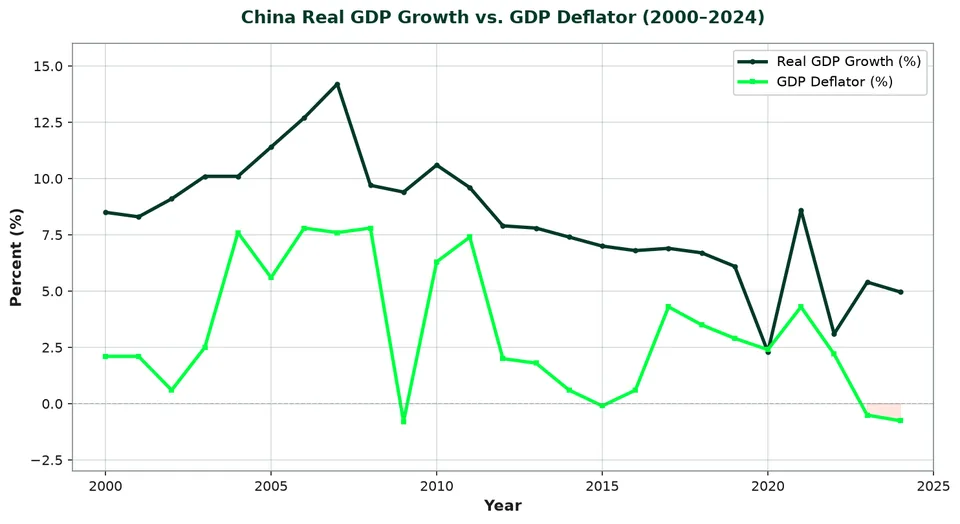
For two decades, China was the unstoppable growth engine that powered global commodity booms and reshaped manufacturing. But that engine is now sputtering — and not in a way a quick rate cut can fix. China has entered a structural deceleration with the most persistent deflationary pressures since the early reform era, and the ripple effects are felt from Australian iron ore mines to American factory floors.
Here's the short version of what's happening.
The headline numbers tell a striking story
China's real GDP growth has slowed from a peak of 14.2% in 2007 to just 4.96% in 2024, according to World Bank data — roughly a third of its height. More concerning is what's happening to prices: the GDP deflator — the broadest measure of economy-wide inflation — turned negative at -0.76% in 2024, marking China's first sustained deflation since the 1990s reform era. Consumer price inflation has collapsed to near zero, and producer prices have been falling for over three years.
This isn't a cyclical dip. It's a structural transition rooted in a growth model that has reached its limits.
A growth model built on shaky foundations
The core problem is a deep imbalance between consumption and investment. Household consumption accounts for just 39.97% of GDP in China, versus 67.91% in the US and 53.07% in Japan, while gross capital formation sits at an extraordinary 40.48% of GDP — unheard of in any other major economy.
That investment-heavy structure generates excess capacity and suppresses returns, and when domestic demand can't absorb the output, produces either deflation at home or trade surpluses abroad. As Michael Pettis of Peking University and the Carnegie Endowment argues, China's deflationary pressures, huge trade surpluses, and unviable investment are consequences of a political obsession with growth targets that exceed sustainable levels of perhaps 2–3%. Because credit is directed toward the supply side rather than household demand, rapid monetary expansion has produced deflation, not inflation.
Eswar Prasad of Cornell and the Brookings Institution has warned since 2023 that China's economy is "sputtering," with collapsed private investment, weak consumption, and rising youth unemployment. He cautions that relying on exports is "dangerous," inviting trade frictions while failing to address weak domestic demand.
The property collapse: China's Japan moment
The property sector — at its peak nearly a third of economic activity and roughly 70% of household wealth — is the single biggest drag on the economy. The downturn began with the "three red lines" policy in August 2020, triggering Evergrande's collapse in 2021. It has persisted for over five years, with new housing starts 75% below the 2021 peak and home prices declining for over 29 consecutive months.
The most cited parallel is Japan's lost decade. Kenneth Rogoff of Harvard and Yuanchen Yang's NBER Working Paper 35054 draws "striking parallels" between China's current real estate adjustment and Japan's 1990s experience — despite profound institutional differences. As the Brookings discussion notes, both countries saw massive overbuilding, housing wealth dominating household balance sheets, and a growth drag operating through investment overhang, wealth effects, and sentiment — independent of banking dynamics. China is aging even faster than Japan did.
The cautionary lesson: the adjustment can last far longer than a decade. As Rogoff and Yang put it, "the window narrows as overcapacity, weak consumption, and negative sentiment reinforce one another."
The sell-side view: moderate growth, persistent deflation
Major financial institutions broadly agree on the trajectory, even if they differ on specifics:
| Institution | 2026 GDP Forecast | Deflation Outlook |
|---|---|---|
| Goldman Sachs | 4.8% | PPI -0.7%; gradually easing |
| JPMorgan AM | 4.5% | Deflation to remain; gradual normalization |
| Bank of America | 4.7% | CPI 0.7%, PPI 0.3% (revised up) |
| Fitch Ratings | 4.1% | Weak domestic demand weighs on prices |
| OECD | 4.5% | Inflation 1–2%; deflation easing |
| IMF (Article IV) | ~4.5% | GDP deflator -0.7% in 2026 |
Goldman Sachs Research, led by Chief China Economist Hui Shan, projects 4.8% growth — above consensus — and expects the current account surplus to rise to 4.2% of GDP, driven by surging exports to emerging markets. Fitch Ratings is the most cautious, limiting 2026 growth to 4.1% due to domestic demand weakness, with unit labor costs falling at their fastest rate since 1998.
But here's the catch: independent assessments tell a different story. Rhodium Group estimates China's actual growth was likely just 2.4–2.8% in 2024 — well below the official ~5%. Capital Economics frames the growth model as "a lose-lose" — deflation at home, disruption abroad. That data reliability gap is itself a critical risk factor for investors.
How China's deflation goes global
China's slowdown transmits to the rest of the world through several channels, and the effects are already visible.
Commodities. The most immediate channel. When Chinese fixed-asset investment decelerated in 2012–2015, copper fell 40%, oil 60%, and iron ore 70%. That drop caused GDP growth in resource-intensive sub-Saharan African countries to fall from 5.3% in 2013 to 1.3% in 2016. Benchmark iron ore has already spent extended periods below $100/tonne in 2026.
Manufacturing competition. China's export prices have fallen ~20% since 2021 while its share of global exports rose from ~12% to ~18%. China now accounts for 28% of global manufacturing output, up from 5% in 2000, with capacity often 2x or more than current production. Nearly 30% of Chinese industrial firms operate at a loss — up from 20% before COVID — yet local governments prop them up rather than allowing market exit, perpetuating the overcapacity that fuels deflationary exports.
Trade reconfiguration. US imports from China fell from roughly $47.7 billion/month in early 2022 to just $21.1 billion in January 2026, reflecting escalated tariffs. As the US share of China's exports declined, shipments to emerging markets rose to around 45% from 34% in 2016. Supply chain exposure to China is increasingly indirect, routed through Southeast Asia and Mexico.
What it means for investors
The bottom line: China's structural slowdown and deflation are not transitory. They represent a multi-year transition reshaping global commodity markets, manufacturing competition, trade flows, and financial risk pricing. Morgan Stanley frames it as a tension between "Old China" — real estate and low-cost manufacturing facing excess capacity — and "New China," transforming in EVs, batteries, robotics, and AI.
Commodity exporters to China — Australia, Brazil, Chile, African resource economies — face structural demand headwinds. Manufacturers in EVs, solar, steel, and batteries confront years of intensifying Chinese price competition. Consumer-facing brands dependent on Chinese demand face a diminished growth market. Chinese equities face structural headwinds, with JPMorgan projecting continued underperformance — though selective opportunities exist in AI and high-tech.
The historical parallels — China's own 1998–2002 deflation, the 2008 stimulus aftermath, and Japan's lost decade — all suggest the adjustment will be prolonged. Without a fundamental rebalancing toward household consumption — the necessary but politically difficult reform — the deflationary pressures and their global spillovers are likely to persist. The window to shape a favorable outcome is narrowing.
Read the full deep-dive version here.
Published Sep 2, 2026 and not updated since. Personal views, not investment advice. See Disclosures.